
Djembe Drum Patterns for Beginners: 3 Essential Rhythms
Master the drum circle with these 3 essential djembe drum patterns for beginners. Learn the notation, the rhythms, and the practice secrets to join the groove.
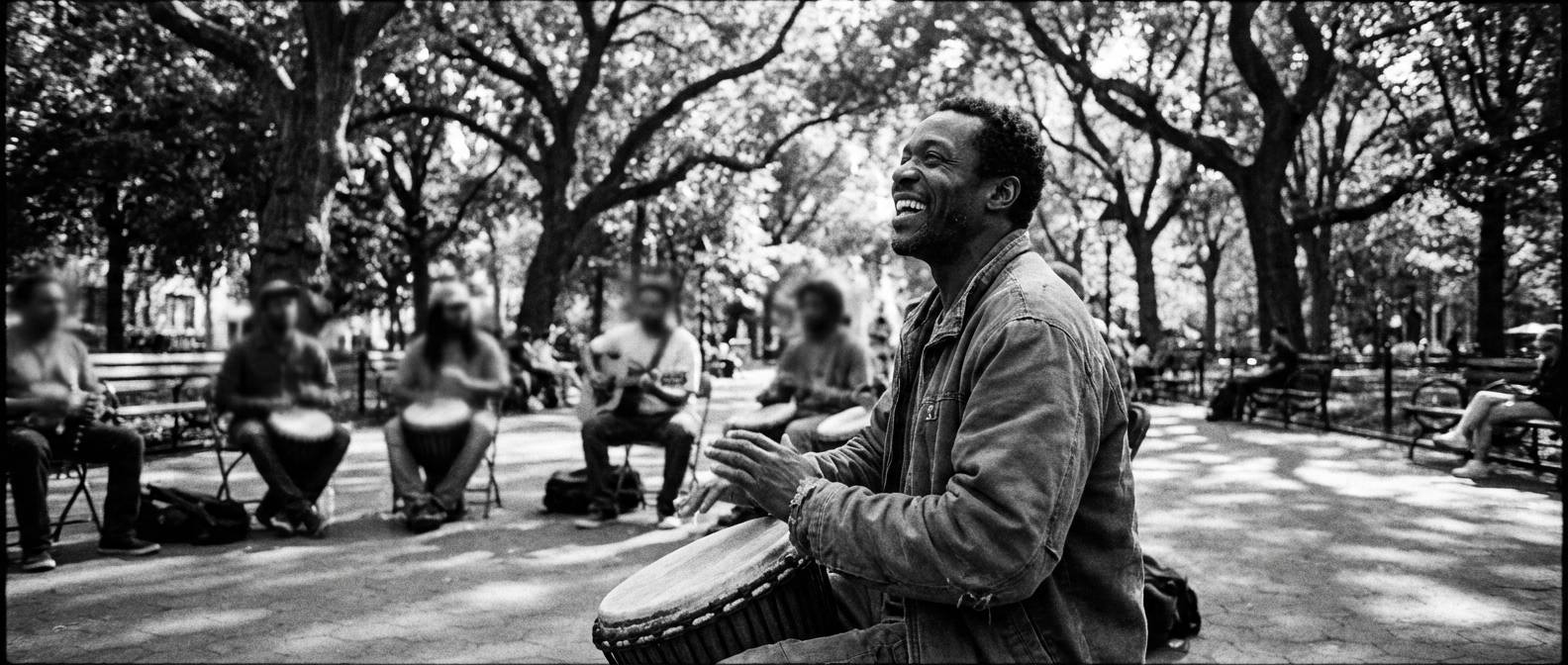
Djembe Drum Patterns for Beginners: 3 Essential Rhythms to Master
You have bought the djembe. You have read our guide on your first djembe lesson and learned how to hit the bass, tone, and slap. You sit down at a drum circle or with a group of friends, and suddenly, you freeze. Everyone else seems to be speaking a fluent language, weaving complex textures together, while you are terrified of playing the wrong note and ruining the groove.
I have seen this anxiety in hundreds of students. The problem isn’t your sense of rhythm; it’s your lack of vocabulary.
If the sounds you make (Bass, Tone, Slap) are the "letters" of the alphabet, then djembe drum patterns are the words and sentences. You cannot have a conversation if you only know the alphabet. Today, we are going to move from making sounds to speaking sentences.
I ran these concepts through my Drum Brain methodology to ensure we are focusing on what actually works physically and musically. We aren't just going to talk about "feeling the vibe." We are going to look at the mechanics of Ostinato—your role as the rhythmic anchor—and learn three specific djembe drum patterns for beginners that will allow you to play in almost any West African percussion setting.
From Sounds to Sentences: The Phonetic System
Before we look at the patterns, we need a way to read them. In West African tradition, rhythms are rarely written down; they are spoken. To learn effective djembe notation, we use a phonetic system that mimics the sound of the drum. This is similar to how we read drum sheet music for a drum kit, but adapted for the tonal nature of hand drumming.
If you try to memorize "Right Hand Bass, Left Hand Slap," your brain will bottleneck. If you memorize a song, like "Gun Pa Gun Go," your hands will follow your voice.
Here is the legend we will use for this article:
- Gun / Dun: The Bass tone (Right Hand / Left Hand). Played in the center of the drum. This creates a low frequency by vibrating the entire air column inside the shell.
- Go / Do: The Open Tone (Right / Left). Played on the rim with fingers held together.
- Pa / Ta: The Slap (Right / Left). Played on the rim, but with fingers relaxed to create a high-pitched "crack."
Note: If you are struggling to make these sounds distinct, you need to revisit the mechanics of your hand placement before attempting these patterns.
Pattern 1: The "Universal Passport" (4/4 Accompaniment)
I call this the "Universal Passport" because it is a djembe accompaniment rhythm that fits over roughly 90% of the 4/4 rhythms you will encounter in a casual drum circle.
When you are a beginner, your role is not to be the soloist. Your role is The Anchor. You are providing a solid, repetitive carpet for the Lead Djembe to walk on. This pattern is often referred to as a simplified "Soli" accompaniment or a general binary groove.
The Structure
This is a 4-beat cycle. The goal here is Vertical Precision. Your "Gun" (Bass) notes must line up perfectly with the pulse (or the Dunun/Bass drum if one is present).
The Notation
| Count | 1 | e | & | a | 2 | e | & | a | 3 | e | & | a | 4 | e | & | a |
|---|---|---|---|---|---|---|---|---|---|---|---|---|---|---|---|---|
| Sound | Gun | Pa | Gun | Go | Gun | Pa | Gun | Go | ||||||||
| Hand | R | L | R | L | R | L | R | L |
How to play it
- Beat 1: Play a Bass (Gun) with your right hand. This is the downbeat.
- The "&" of 1: Play a Slap (Pa) with your left hand.
- Beat 2: Play a Bass (Gun) with your right hand.
- The "&" of 2: Play a Tone (Go) with your left hand.
Why this works
This pattern alternates hands (Right-Left-Right-Left), which is physically efficient. It provides the low end (Bass) to lock in the time, a high pitch (Slap) to add energy, and a mid-range pitch (Tone) to add melody. If you get lost in a jam session, fall back to this. It is one of the most useful easy djembe rhythms you will ever learn.
Pattern 2: Kuku (The Celebration Rhythm)
Now we move to a specific traditional rhythm. Kuku is a popular rhythm from the forest region of Guinea and the Ivory Coast. It was traditionally played when women returned from fishing, and it is now a staple of celebration.
Learning how to play the Kuku rhythm on djembe is a rite of passage for beginners. It introduces a slightly more syncopated feel than the Universal Passport.
The Structure
Kuku is in 4/4 time, but it has a swing to it. It shouldn't feel robotic; it should feel like it's "skipping" slightly. The interaction between the bass and tone here creates a melody that is distinct and recognizable.
The Notation (First Accompaniment)
| Count | 1 | e | & | a | 2 | e | & | a | 3 | e | & | a | 4 | e | & | a |
|---|---|---|---|---|---|---|---|---|---|---|---|---|---|---|---|---|
| Sound | Pa | Pa | Gun | Go | Pa | Pa | Gun | Go | ||||||||
| Hand | R | L | R | L | R | L | R | L |
Note: In some variations, the "Go" (Tone) is replaced by another "Gun" (Bass). Listen to the lead drummer to see which fits better.
Execution Tips
Notice that the phrase starts with two Slaps (Pa - Pa). This immediately grabs attention. The "Gun - Go" that follows lands on the beat and the "e" of the beat.
To really lock this in, I recommend listening to the Kuku backing tracks on Drum Notes. You can hear how the djembe part interlocks with the bass drums (Dununs), which is difficult to understand if you are practicing in isolation.
Pattern 3: Introducing 6/8 (The Triplet Feel)
West African music is famous for its use of 6/8 time signatures. This is where many students get confused.
In 4/4 (like the previous patterns), the rhythm feels like a square march: ONE-two-three-four. In 6/8, the rhythm feels like a rolling wheel or a waltz: ONE-two-three, FOUR-five-six.
To master djembe drum patterns for beginners, you must be comfortable with this "triplet" feel. This pattern is a standard accompaniment used in rhythms like Afro or Moribayassa.
The Notation
| Count | 1 | 2 | 3 | 4 | 5 | 6 | | :--- | :--- | :--- | :--- | :--- | :--- | | Sound | Gun | Pa | Ta | Gun | Pa | Ta | | Hand | R | L | R | L | R | L |
How to play it
- Count aloud: "ONE, two, three, FOUR, five, six." Emphasize the ONE and the FOUR.
- The Hands: Your hands simply alternate R-L-R L-R-L.
- The Melody: The Bass (Gun) lands on the pulses (1 and 4). The Slaps (Pa/Ta) fill in the space between.
Physics of the Movement
In 6/8, your arms should move in a more circular, flowing motion compared to the up-and-down piston motion of 4/4. Relax your shoulders. The groove comes from the accent on the Bass notes. If all notes are the same volume, it will sound like a machine gun, not music.
How to Practice: The Loop and The Distraction
Knowing the notation is only 10% of the work. The other 90% is muscle memory. You need to push these patterns from your conscious brain (which is slow) to your subconscious brain (which is fast).
Here is the protocol I use with my students at Upbeat Studio:
- Vocalize First: Say the pattern out loud ("Gun Pa Gun Go") while clapping the beat. If you can't say it, you can't play it.
- The 5-Minute Loop: Set a timer. Play one pattern for 5 minutes without stopping. Do not fill, do not solo. Just hold the line. This builds the physical stamina required for drumming, similar to the discipline we teach in our practice pad guide.
- The Distraction Test: This is the ultimate proof of mastery. Try to play the pattern while watching TV, or while having a conversation with someone.
If you stop playing when you start talking, you haven't mastered the ostinato yet. The rhythm needs to be automatic.
I often use the custom practice generator in Drum Coach to set up these specific duration drills. It helps to have a metronome that tracks your consistency over time, ensuring you aren't rushing (speeding up) or dragging (slowing down).
Conclusion
You don't need to know 50 rhythms to be a great djembe player. You need to know three or four, but you need to play them with impeccable timing and tone.
By mastering the "Universal Passport," the Kuku accompaniment, and the basic 6/8 triple feel, you have equipped yourself with a rhythmic vocabulary that allows you to enter the conversation. The next time you sit at a drum, don't worry about soloing. Lock in one of these easy djembe rhythms, listen to the bass drums, and become the anchor that holds the group together. That is the most valuable role you can play.
Now, go find a drum circle and put these sentences to use.
Frequently Asked Questions (FAQ)
What is the easiest djembe rhythm for beginners?
The "Universal Passport" (Bass - Slap - Bass - Tone) played in 4/4 time is generally considered the easiest and most versatile rhythm. It requires simple hand alternation (Right-Left-Right-Left) and fits into the majority of modern drum circle grooves.
How to play the Kuku rhythm on djembe?
The basic accompaniment for Kuku is a 4-beat pattern. A common sticking pattern is Right-Left-Right-Left. The phonetic phrasing is "Pa - Pa - Gun - Go" (Slap - Slap - Bass - Tone), giving the rhythm its characteristic happy, skipping feel.
What are the basic djembe accompaniment patterns?
The three most essential accompaniment categories are:
- The Binary Beat (4/4): Used for rhythms like Soli.
- The Ternary Beat (6/8): Used for rhythms like Afro or Fanga.
- The Off-beat Clave: Patterns that emphasize the space between the beats (more advanced).
How to read djembe notation using Gun, Go, Pa?
"Gun" and "Dun" represent the low Bass tone played in the center. "Go" and "Do" represent the Open Tone played on the rim. "Pa" and "Ta" represent the high-pitched Slap. The first letter (G, D, P) usually indicates the right hand (for righties), while the others indicate the left.
What is the difference between 4/4 and 6/8 djembe rhythms?
It comes down to the "feel" of the pulse. 4/4 rhythms feel square and marching (1-2-3-4). 6/8 rhythms feel circular and rolling, based on triplets (1-2-3, 4-5-6). Using the wrong feel in a song will clash with the other musicians.
YOU MIGHT ALSO LIKE
How to Read Drum Sheet Music: The Ultimate Guide to Rhythm Literacy
Unlock the language of rhythm! Learn how to read drum sheet music with our step-by-step guide. Master the staff, symbols, and counting systems today.

Marching Drumline Instruments: The Anatomy of a Modern Battery
Explore the anatomy of a modern marching drumline. From high-tension snares to the front ensemble, learn the physics and instruments of the battery.
Drum Rudiments for Beginners: 5 Essential Patterns to Master
Unlock speed, control, and musicality with this guide to 5 essential drum rudiments for beginners. Master singles, doubles, and paradiddles today.