
Samba Batucada Instruments: A Technical Guide to Brazilian Percussion
A technical guide to Samba Batucada instruments. Learn the hierarchies, Surdo patterns, Tamborim virado technique, and how to tune for authentic Brazilian sound.
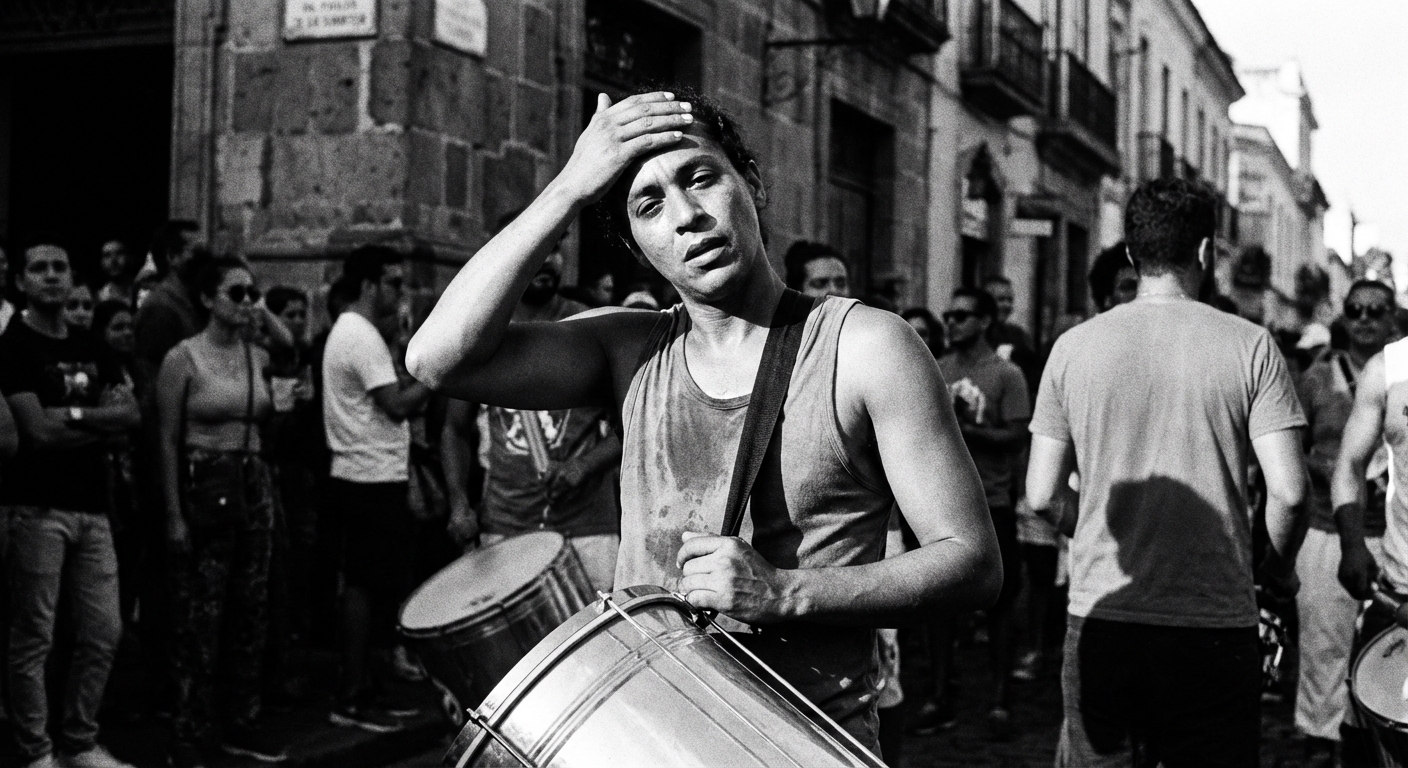
Samba Batucada Instruments: A Technical Guide to Brazilian Percussion
You have likely heard the roar of a Batucada ensemble from blocks away. It is physical, visceral, and overwhelming. But when you try to join in or replicate that sound on your kit, you often find yourself lost in a wash of noise rather than contributing to the groove.
The problem isn't usually a lack of enthusiasm; it's a lack of structural understanding. Samba isn't just "playing fast and loud." It is a complex machine where every gear—from the deep Surdo to the piercing Tamborim—must interlock with mathematical precision. If one gear slips, the machine breaks.
To play Samba, you must stop thinking of it as a "feeling" and start understanding it as an orchestration of physics and anatomy. Whether you are holding a repique stick or sitting behind a drum kit trying to emulate a 20-piece percussion section, the principles of mechanics remain the same.
Using the insights from our Drum Brain methodology at Upbeat Studio, we are going to deconstruct the Samba Batucada. We will move beyond simple definitions and dive into the specific techniques, hierarchies, and tuning methods you need to build a rhythmic engine that actually works.
The Hierarchy of the Ensemble (The "Orchestra" Analogy)
Before picking up a stick, you must understand your place in the sonic spectrum. A Batucada is organized strictly by frequency and rhythmic function, much like a symphony orchestra. In a classical setting, you wouldn't have the tubas playing the piccolo part. In Samba, this separation of duties is even more critical because the sheer volume of the drums can easily turn into mud if everyone plays everything at once.
If everyone tries to play the "fun" syncopated parts, the groove collapses. We categorize the instruments into three distinct layers based on their frequency range and their job within the measure:
- The Foundation (The Bass): The Surdos. These instruments provide the pulse and the time. They are the "feet" of the samba, grounding the entire school. Without them, there is no reference point for the dancers or the other musicians.
- The Engine (The Motor): The Caixa (Snare) and Repique. These provide the constant sixteenth-note subdivision that drives the momentum forward. They fill in the space between the bass notes, creating a carpet of sound that propels the music.
- The Color (The Articulation): The Tamborim, Agogô, and Chocalho/Ganza. These sit in the high frequency range and provide the syncopation and melody that floats on top. They are responsible for the "swing" and the specific flavor of the samba school.
Understanding this hierarchy is crucial. If you are playing a Surdo, you cannot play loosely; you are the metronome. If you are playing the Caixa, you are the texture. If you are on the Agogô, you are the melody.
The Engine Room: Mastering the Surdos
The Surdo is the heartbeat of Samba Batucada. It is a large, deep-shell drum played with a soft mallet. However, treating it like a generic bass drum is a mistake. There are three specific roles you must distinguish, and mixing them up is the quickest way to get cut from a bateria.
The Surdo Roles
- Surdo 1 (Primeira): The largest drum with the deepest pitch. It plays on beat 2 (in 2/4 time). This is the downbeat anchor. It is the heaviest note in the measure and answers the call of Surdo 2.
- Surdo 2 (Segunda): Slightly smaller, pitched higher. It plays on beat 1. It initiates the cycle. The interplay between the "1" of the Segunda and the "2" of the Primeira creates the fundamental "Hump-Cha" motion of samba.
- Surdo 3 (Terceira or Cortador): The smallest and highest pitched. It plays variations and syncopations between the main beats. It "cuts" (hence Cortador) through the heavy pulse of the 1 and 2, adding swing and complex counter-rhythms.
Technique: Vertical Precision and The "Zipper"
The magic of the Surdo section happens when Surdo 1 and Surdo 2 lock together. In my teaching, I refer to this as Vertical Precision.
Imagine a zipper. The teeth on the left (Surdo 2) and the right (Surdo 1) must mesh perfectly without gaps. If Surdo 2 is late, or Surdo 1 is early, you get a "flam" sound that destroys the energy of the battery. The notes must be distinct, yet connected.
How to execute the stroke:
- Grip: Hold the mallet with a German grip (palms down) for maximum rebound utilizing gravity. This allows the heavy mallet to do the work. If you try to control it with your fingers like a French grip, you will lose power and likely injure your wrist. For a refresher on the mechanics of this grip, check out our guide on how to hold drum sticks correctly.
- The Mute: The non-mallet hand plays a vital role. It rests on the head to dampen the sound between strikes. You strike the drum, let it resonate for the exact duration of the note, and then dampen it immediately as the other Surdo plays. This clarity is essential.
- The Strike: Aim for the center of the head. Do not bury the beater. Allow the mallet to bounce off the head to pull the low-end frequencies out of the shell. A buried beater will choke the drum and sound thin.
If you are struggling to keep your Surdo patterns steady, I highly recommend using the custom practice tracks in Drum Coach to isolate the beat and force yourself to lock in with a metronome rather than relying on other musicians.
The Driving Force: Caixa & Repinique
The mid-range of the Batucada is where the energy lives. This section requires immense stamina and loose wrists. While the Surdos are the heartbeat, the Caixa and Repinique are the adrenaline.
Caixa de Guerra (Snare Drum)
Unlike the American marching snare, which is often tuned dry and articulate, the Brazilian Caixa is tuned high and resonant with wires (snares) often on the top head. This gives it a wet, buzzing sound that fills the sonic spectrum.
The "Embolo" Pattern: The basic groove for the Caixa is not a backbeat (2 and 4). It is a continuous stream of sixteenth notes with specific accents. The goal is to create a "rolling" feel that mimics the motion of a train.
Step-by-Step Execution:
- Sticking: You can use a specific sticking pattern, but many players use a hand-to-hand alternate sticking (R L R L) to maintain flow at high tempos.
- The Accent: The accent usually falls on the "ah" of the beat (1 e & a 2 e & a). This syncopation pushes the music forward, creating a feeling of falling into the next beat.
- Anatomy: You cannot play this from your elbows. The motion must come entirely from the wrist and fingers. If you tense up, you will fatigue in under a minute. Keep your fulcrum loose. For exercises to build this specific type of endurance, refer to our essential drumming techniques.
Repinique (The Caller)
The Repinique is a high-pitched drum played with one stick and one bare hand. It serves as the conductor, signaling breaks and calls (Chamadas). It is the tenor voice of the drum section.
The Technique: The stick hand plays rimshots almost exclusively to cut through the volume of the Surdos. These aren't the accidental rimshots of a rock drummer; they are intentional, piercing cracks. The bare hand fills in the "ghost notes" on the skin. The interplay between the sharp crack of the stick and the dry slap of the hand creates the signature Repinique gallop.
The High End: Tamborim & Agogo
This is where beginners often struggle the most because the technique is counter-intuitive. These instruments are small, but they are loud and technically demanding.
The Tamborim: It’s Not Just a Hitting Game
The Tamborim is a small, 6-inch frame drum. The standard pattern is the Telecoteco (3-1-2-1 pattern). However, simply hitting the drum fast is physically impossible at high tempos (140+ BPM). You will lock up your forearm.
You must use the "Virado" (Turning) Technique.
How to do the Virado: Instead of moving the stick up and down for every note, you rotate the drum itself with your non-dominant hand. This is a game of physics: bringing the target to the weapon.
- The Setup: Hold the stick in your dominant hand and the drum in your other hand. Keep the stick hand relatively stationary, moving only slightly up and down.
- The Motion: On the "3" count of the pattern, you flip the drum upside down and hit it on the upstroke.
- The Physics: This cuts the work of your stick hand in half. You are using the rotation of the drum to meet the stick. It looks like a figure-eight motion with the left hand.
Mastering the Virado takes weeks of slow practice to coordinate the rotation of the left wrist with the striking of the right hand. If you try to brute-force this with just wrist speed, you risk tendinitis.
Agogô
The Agogô bells provide the melodic line. The interval between the two bells (low and high) creates a rhythmic melody. The classic pattern mimics the Tamborim but with more freedom. Focus on striking the "sweet spot" of the bell (near the open mouth) for maximum resonance. Do not hit the closed end, as it sounds clunky and dull.
Samba Reggae vs. Samba Batucada: Understanding the Swing
It is important to note that not all Brazilian drumming is "Samba Batucada." A common confusion arises between the Rio style (Batucada) and the Bahia style (Samba Reggae).
- Samba Batucada (Rio): This is the fast, swinging carnival style. It feels like a galloping horse. The 16th notes are slightly swung, and the emphasis is heavily on the "2".
- Samba Reggae (Bahia): This style is slower and "straighter." It has a heavy influence from Jamaican Reggae and African rhythms. The Surdos often play complex counter-rhythms with multiple mallets, and the groove sits deeper in the pocket. It does not have the frantic forward momentum of Batucada; instead, it has a powerful, majestic stomp.
Knowing which style you are playing is critical for choosing the right instrument tuning and patterns.
From Ensemble to Drum Set: The "One-Man Batucada"
For drum set players, the goal is to simulate this entire ensemble using four limbs. This requires what we call Genre-Specific Independence in our curriculum. You are essentially acting as the conductor and the orchestra simultaneously.
You must decouple your limbs to assign them roles from the Batucada:
- Feet (The Surdos): Your feet take the role of the Surdos.
- Option A (Baiao/Samba foot): Right foot plays the ostinato (dot-dot... boom).
- Option B (Batucada Style): Right foot plays Beat 2 (Surdo 1), Left foot plays Beat 1 (Surdo 2) on the Hi-Hat or a second pedal. This creates the "Zipper" effect between your feet.
- Hands (The Color): Your hands take the role of the Caixa and Tamborim.
- Right Hand: Plays the Telecoteco pattern on the rim of the snare or a woodblock (mimicking the Tamborim).
- Left Hand: Fills in the ghost notes on the snare (mimicking the Caixa).
To master this independence, start by practicing the hand patterns on a pad while keeping a simple pulse with your feet. You can find excellent exercises for this in our article on how to practice with your drum pad.
Additionally, finding transcriptions of these specific limb combinations is vital. You can browse the user-created scores in Drum Notes, which is excellent for visualizing how these independent lines stack vertically. If you need help decoding these scores, our guide on reading drum notation is a great resource.
Tuning and Maintenance for the Tropics
A common mistake I see is drummers trying to play Samba on a rock-tuned kit. It simply won't sound authentic. Samba drums are tuned to cut through outdoor environments and humidity. They need to project over thousands of people.
The "Vocalist" Tuning Approach: Think of your drums as a choir.
- Surdos: Tune them to specific intervals. A common tuning is a Perfect 4th or 5th between Surdo 2 and Surdo 1. They should boom, but not sustain forever like a jazz kick drum. Use muffling foam if necessary to shorten the decay. The note should be a punch to the chest, not a rumble.
- Caixa & Repinique: Crank them tight. The Caixa needs to sound dry and crisp—almost like a gunshot. The Repinique should be tuned as high as the head allows without choking. This high tension facilitates the rebound needed for fast rolls.
- Heads: Brazilians typically use synthetic heads (often white napa or clear plastic) because they are durable and bright. Avoid coated heads if you want that authentic, sharp attack. Coated heads tend to warm up the sound too much for this genre.
Conclusion
Samba Batucada is a discipline that demands respect for the instrument and the culture. It is not about chaos; it is about the organized layering of rhythms to create a wall of sound that compels people to move.
Start with the Surdo pulse. If you cannot feel that "1-2" weight, nothing else matters. Build your endurance on the Caixa slowly, focusing on loose wrists. And tackle the Tamborim turn with patience—it is a complex biomechanical motion that cannot be rushed.
Do not just play the notes; understand the function of the gear you are holding in the great machine of the rhythm. When the machine is working, the feeling is undeniable.
Frequently Asked Questions
What are the main instruments in a Samba Batucada ensemble?
The core ensemble consists of the Surdos (Bass), Caixa (Snare), Repinique (Tenor/Caller), Tamborim (High percussion), Agogô (Bells), and Chocalho/Ganzá (Shakers). Each has a specific frequency range to ensure the sound is full but not muddy. The Surdos provide the low end, the Caixa and Repinique provide the mid-range drive, and the Tamborim and Agogô provide the high-end articulation.
How do you play the basic Telecoteco pattern on a Tamborim?
The Telecoteco is often counted as a "3-1-2-1" groupings of sixteenth notes. To play it fast, you must use the Virado technique, where you rotate the drum upside down for the third note of the sequence, allowing for an upstroke that conserves energy and increases speed. This prevents the forearm from locking up at high tempos.
What is the difference between Surdo 1, Surdo 2, and Surdo 3 in Samba?
Surdo 1 (Primeira) is the deepest drum and marks the second beat (the downbeat). Surdo 2 (Segunda) is slightly higher and marks the first beat. Together, they create the heartbeat. Surdo 3 (Terceira) is the smallest and highest, playing syncopated variations ("cutting") between the main beats to add swing and complexity.
How to tune Samba drums for an authentic Batucada sound?
Samba drums are generally tuned much higher than rock drums. The Caixa and Repinique should be very tight for a sharp, cracking sound. The Surdos should have distinct intervals (usually a 4th or 5th apart) and controlled resonance so the notes don't bleed into each other. Using synthetic heads helps achieve the bright, cutting tone required for outdoor playing.
What are the essential Samba Reggae vs. Samba Batucada rhythmic differences?
Samba Batucada (Rio style) is faster, with a heavy emphasis on the "2" beat and a driving 16th-note swing. Samba Reggae (Bahia style) is generally slower, straighter (less swing), and often features the Surdos playing complex counter-rhythms closer to Jamaican dancehall or reggae patterns, often using multiple sticks on the Surdo.
YOU MIGHT ALSO LIKE
How to Read Drum Sheet Music: The Ultimate Guide to Rhythm Literacy
Unlock the language of rhythm! Learn how to read drum sheet music with our step-by-step guide. Master the staff, symbols, and counting systems today.
Marching Drumline Instruments: The Anatomy of a Modern Battery
Explore the anatomy of a modern marching drumline. From high-tension snares to the front ensemble, learn the physics and instruments of the battery.
Drum Rudiments for Beginners: 5 Essential Patterns to Master
Unlock speed, control, and musicality with this guide to 5 essential drum rudiments for beginners. Master singles, doubles, and paradiddles today.