
Drumming Confidence Tips: Stop Shaking and Start Grooving
Stop shaking and start grooving. Learn 5 drumming confidence tips to overcome stage fright, master your internal clock, and play with authority.
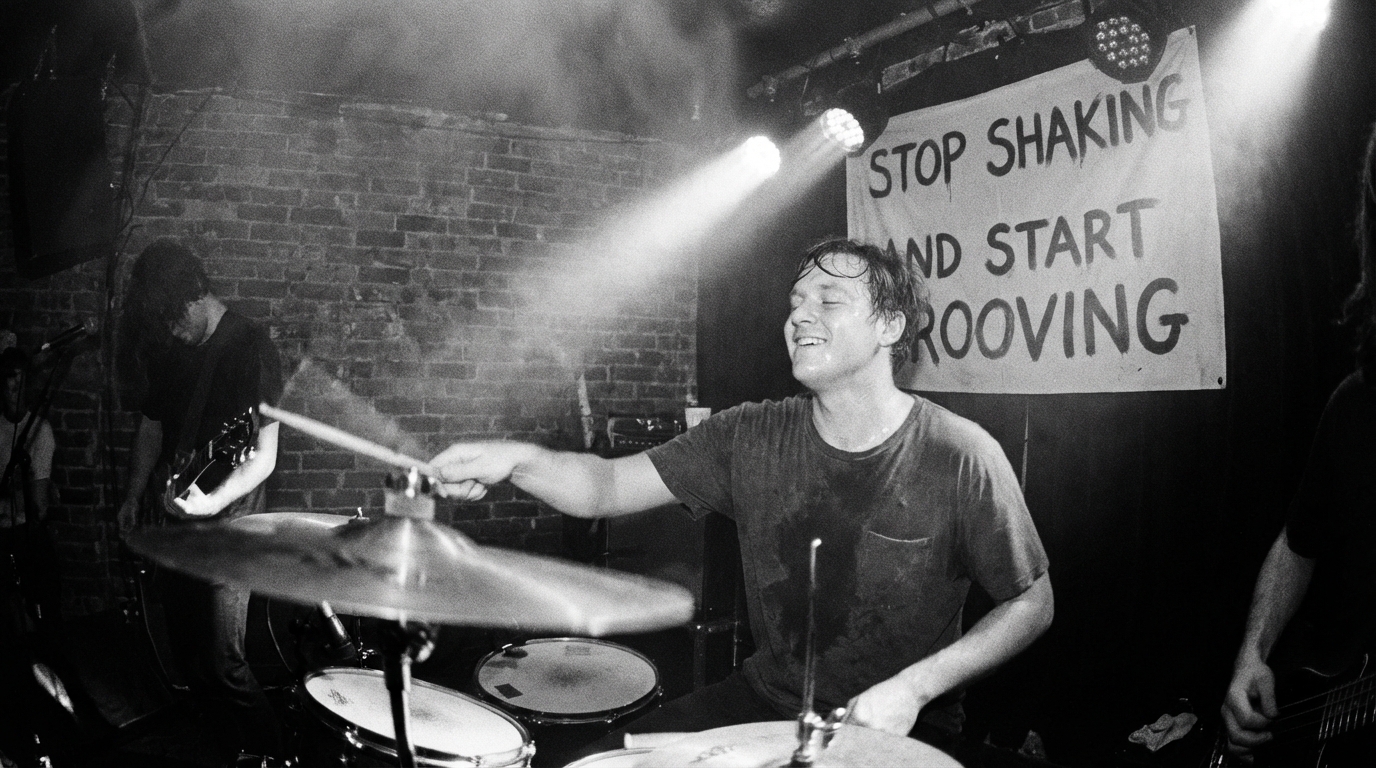
Drumming Confidence Tips: Stop Shaking and Start Grooving
You are about to count off the next song. Your sticks are raised, but your heart is hammering against your ribs like a double-kick pedal. Your palms are slick. A singular, terrifying thought loops in your mind: "I’m going to lose the beat, the band will glare at me, and I’ll look like a fraud."
I know this feeling intimately. Every drummer does. From the garage hobbyist to the stadium pro, the fear of the "train wreck" is universal.
But here is the harsh truth I have learned over 20 years of teaching and playing: Confidence is not a feeling you wait for. If you wait to "feel" ready, you never will be. Confidence is a mechanical byproduct. It is an equation: Competence + Mental Framing = Confidence.
When you see a drummer playing with effortless swagger, you aren’t seeing bravery. You are seeing a library of physical habits and mental strategies that protect them from failure. You are seeing physics and psychology working in harmony.
To stop shaking and start leading the band, we need to move away from generic "believe in yourself" advice and look at the actual mechanics of stage fright, the anatomy of control, and the specific drumming confidence tips that turn anxiety into authority.
The Root of Insecurity: Why We Freeze on Stage
Why do you play perfectly alone in your basement but stiffen up the moment someone is watching?
The problem is cognitive load. When you are practicing, you are often in a state of "flow." When you are nervous, your brain shifts from the subconscious "doer" to the conscious "monitor." You stop playing the drums and start thinking about playing the drums.
This is fatal. The conscious brain is too slow for drumming. By the time you think "hit the crash," the moment has passed.
We call the solution "The Autopilot."
Your goal is to push your skills from Conscious Competence (I can do it if I focus hard) to Unconscious Competence (I can do it while ordering a pizza). When your limbs know the geometry of the kit without your permission, anxiety loses its power. You can be terrified, but your hands will still execute the paradiddle because the neural pathway is deeper than the fear.
The following strategies are designed to build this autopilot and hack your brain’s response to stress.
Physical Safety Net: Fixing Mechanics for Confidence
Insecurity often manifests physically. You tense up. Your shoulders rise toward your ears. You grip the sticks as if you are strangling them. This physical tension reinforces the mental signal that you are in danger, creating a feedback loop of panic.
To break this, you need a physical safety net. This comes down to two non-negotiable essential drumming techniques: The Fulcrum and The Cockpit.
1. The Fulcrum is Your Anchor
I won’t bore you with a basic lesson on how to hold drum sticks—you likely already know that. But you need to understand the psychological role of the fulcrum (the pivot point where your thumb and index finger meet).
When nerves hit, the instinct is to grab harder. This kills the rebound. When the stick doesn't bounce, you have to work twice as hard to lift it, leading to fatigue and rushing.
You must train your fulcrum to be your "home base." If you trust that your fulcrum is secure, you can relax the back fingers. When you relax the back fingers, the stick does the work.
The Confidence Check: Before you start playing, wiggle your back fingers against the palm while holding the stick. If you can move them freely, your fulcrum is doing its job. This simple check signals to your brain: I am in control of the stick; the stick is not controlling me.
2. The Cockpit: Posture as Power
Your throne isn't just a chair; it is your command center. We call a proper setup "The Cockpit."
If you sit too low or slouch, your center of gravity shifts backward. To reach the toms or cymbals, you have to lunge, throwing you off balance. Your brain senses this instability and triggers a "danger" alert, increasing your anxiety.
Sit high enough that your hips are slightly above your knees. Keep your spine stacked. When you sit tall, two things happen:
- Physics: Your limbs have a full range of motion without compromising your balance.
- Psychology: This is "power posing." Sitting upright lowers cortisol (stress hormone) and increases testosterone (confidence hormone).
By simply adjusting your throne and straightening your spine, you are hacking your brain chemistry to feel more assertive.
The Mental Game: Overcoming Mistakes with Strategies
What happens when you drop a stick? or miss a crash? or hit the rim instead of the snare?
For the anxious drummer, this triggers the Spiral of Shame. You make one mistake, you panic, you tense up, and then you make three more mistakes because you are focusing on the past rather than the current beat.
Professional drummers handle mistakes differently. We use The Bob Ross Rule: "We don't make mistakes, just happy accidents."
This isn't just a nice saying; it's a tactical response. If you accidentally hit a rimshot on beat 2 instead of beat 4, do not cringe. Do it again.
If you repeat a "mistake," it becomes a musical choice. It becomes a syncopated pattern. It becomes jazz. The audience doesn't know what you intended to play; they only know what they hear. If you play it with conviction and repeat it, you validate it.
How to Practice Recovery:
- Play a simple groove.
- Intentionally drop a stick or hit the wrong drum.
- Force yourself to keep the bass drum going without wavering.
- Recover calmly.
By practicing the recovery, you remove the terror of the error. You realize the world didn't end, the song didn't stop, and you are still driving the bus.
Solidifying Time: Building an Unshakeable Internal Clock
Nothing destroys drumming confidence faster than the feeling that you are drifting. Are we rushing? Is the bassist dragging? If you don't trust your internal clock, you will always be a follower, nervously reacting to the band rather than leading them.
To build unshakable confidence, you must know where "One" is, even in total silence. We build this using Gap Click Practice. This is a staple in learning how to practice with your drum pad effectively.
The Gap Click Strategy
Most drummers use a metronome to keep them in time. This is a crutch. You want to use the metronome to verify your time.
- Level 1: Set your metronome (I use the tools in Drum Coach for this) to play 3 bars of click, followed by 1 bar of silence.
- The Test: Play a groove. When the click drops out, keep playing. When the click returns on the "One" of the next bar, are you locked in? Or did you drift?
- Level 2: Move to 2 bars of click, 2 bars of silence.
This is brutal practice. You will fail at first. But as you get better, you stop relying on the external click and start developing a burning internal pulse.
When you walk onto a stage knowing that you can hold a tempo through four bars of silence without flinching, stage fright evaporates. You don't hope you are on time; you know you are.
The Truth Serum: Recording Drums for Fast Improvement
Insecurity feeds on the unknown. We imagine we sound terrible, which makes us play timidly, which actually makes us sound terrible.
The cure is objective data. You must record yourself.
I call this the Truth Serum. It tastes bad going down, but it cures the disease.
- Record every practice session. You don't need a studio; a phone memo is fine.
- Listen back immediately.
- Analyze without emotion.
Don't say, "I suck." Say, "My kick drum is rushing slightly on the fills," or "My left hand ghost notes are too loud."
When you identify specific technical issues, the vague monster of "I'm not good enough" disappears. It is replaced by a concrete to-do list. "Fix rushing kick drum" is a solvable problem. "Be a better drummer" is an overwhelming burden.
I often have my students use Drum Notes to write down the specific groove they are working on, record it, and then listen back while reading the score. This visual-auditory connection highlights exactly where the confidence gaps are so we can fill them with technique. If you aren't sure how to do this, check out our guide on decoding drum notes.
Performance Prep: Controlling Adrenaline Before the Gig
Let’s talk about the biology of the gig. You are about to start. Your body dumps adrenaline into your bloodstream. This is the "fight or flight" response.
Adrenaline does something tricky to drummers: It distorts time perception.
Under high adrenaline, time feels slower to you. This means that if you play a beat at a tempo that feels comfortable, you are almost certainly rushing. You are playing at 130 BPM when the song is 120 BPM.
You cannot stop the adrenaline, but you can surf it.
The Pre-Show Protocol
Do not jump on the kit and start bashing immediately. You need to calibrate your internal clock to reality.
- Deep Breathing: Two minutes before you play, breathe in for 4 seconds, hold for 4, out for 4. This engages the parasympathetic nervous system and lowers your heart rate.
- Slow Rudiments: Play single strokes on a pad or your leg. Play them painfully slow. Force your brain to acknowledge the space between the notes.
- Sing the Tempo: Before you count off, sing the chorus of the song in your head. People tend to sing choruses at the correct tempo. Use that mental playback to set your count-off.
Conclusion: From Thinking to Knowing
Confidence is not a personality trait reserved for extroverts. It is the transition from thinking to knowing.
It is knowing that your fulcrum will hold. Knowing that if you drop a stick, you can recover. Knowing that your internal clock is calibrated. Knowing that you have put in the reps.
This journey requires structure. It requires moving beyond mindless jamming and embracing focused, sometimes difficult, practice. This is why I built the methodologies inside Drum Coach—to give you the daily discipline that creates mechanical certainty.
When you trust your mechanics, you are free to stop working and start playing. You can look up from your snare drum, make eye contact with your bassist, and actually enjoy the music.
That is the goal. Not perfection, but presence.
Now, take a deep breath, sit up straight, and hit the one.
Frequently Asked Questions
How can I overcome stage fright when playing drums?
Stage fright often comes from a lack of preparation or fear of the unknown. Combat it by "over-preparing" your material—know the song structures inside out. Use the "Gap Click" method to ensure your timing is solid. Finally, accept that adrenaline is normal; use deep breathing before you play to calm your nervous system.
Why do I lose the beat when I get nervous?
Nerves trigger an adrenaline rush, which speeds up your perception of time. This makes a steady tempo feel "slow," causing you to rush. Additionally, anxiety causes muscle tension, which disrupts your natural flow and timing. Practice playing with a click track and focus on relaxing your grip to counteract this.
How to build confidence as a beginner drummer?
Focus on small, consistent wins. Instead of trying to learn a complex solo, master one simple groove perfectly. Record yourself to prove to your brain that you are improving. Use a structured path, like the levels in Drum Coach, to track your progress visually. Confidence comes from seeing how far you've come.
What is the best mindset for drumming practice?
Adopt a "scientist" mindset rather than a "performer" mindset during practice. You are there to experiment, fail, and gather data, not to put on a show. If you mess up, don't get angry—get curious. Ask why it happened (e.g., "Was my posture bad? Did I lose count?") and fix the variable.
How do professional drummers handle mistakes on stage?
Pros don't stop; they recover. They keep the time going at all costs (usually the bass drum). They often repeat the "mistake" to make it sound intentional, or they smile and move on. They understand that the audience usually won't notice a slip-up unless the drummer makes a face or stops playing.
YOU MIGHT ALSO LIKE

How to Read Drum Sheet Music: The Ultimate Guide to Rhythm Literacy
Unlock the language of rhythm! Learn how to read drum sheet music with our step-by-step guide. Master the staff, symbols, and counting systems today.

Marching Drumline Instruments: The Anatomy of a Modern Battery
Explore the anatomy of a modern marching drumline. From high-tension snares to the front ensemble, learn the physics and instruments of the battery.
Drum Rudiments for Beginners: 5 Essential Patterns to Master
Unlock speed, control, and musicality with this guide to 5 essential drum rudiments for beginners. Master singles, doubles, and paradiddles today.