
Drum Rudiments for Beginners: 5 Essential Patterns to Master
Unlock speed, control, and musicality with this guide to 5 essential drum rudiments for beginners. Master singles, doubles, and paradiddles today.
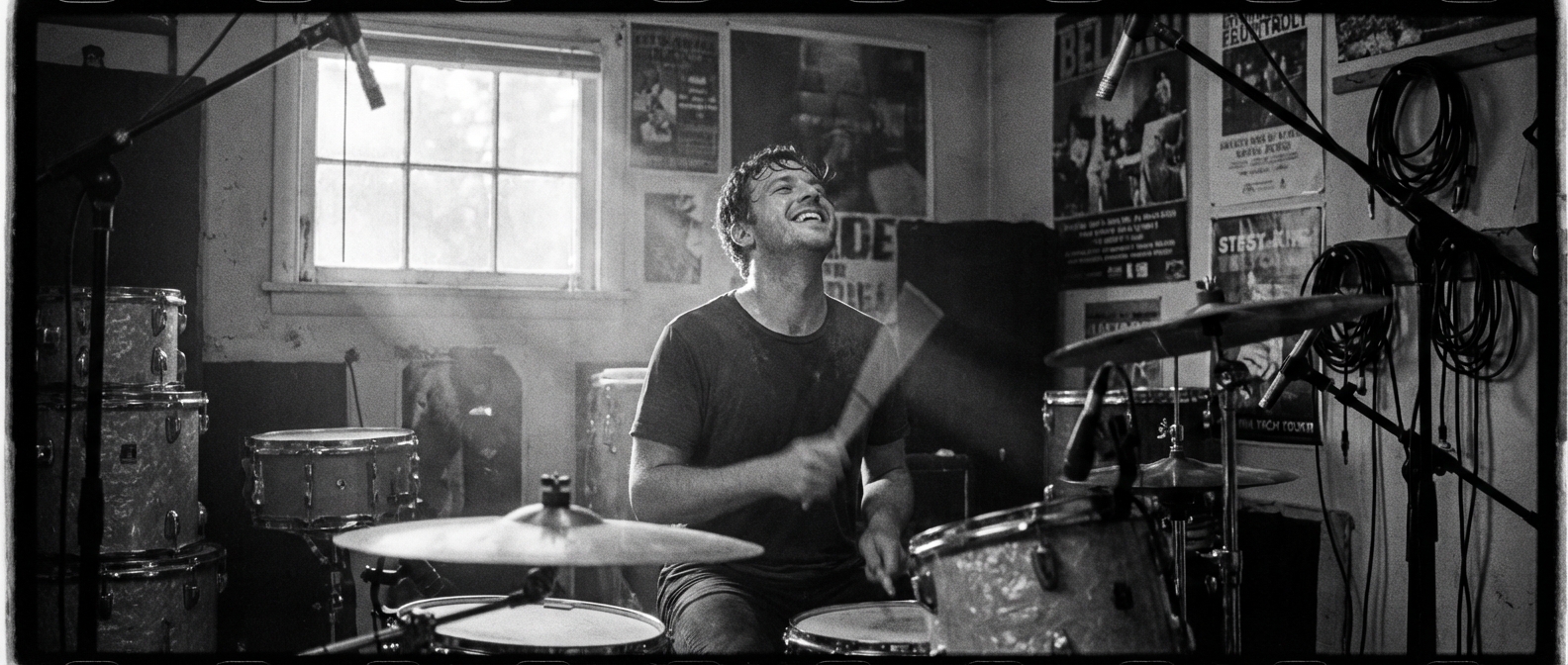
Drum Rudiments for Beginners: 5 Essential Patterns to Master First
You are sitting at your kit, humming a rhythm in your head. It sounds powerful, fast, and creative. But when you try to play it, your hands fumble. The sticks click together, the timing feels "lumpy," and the speed just isn't there.
This is the most common frustration I see in students. The disconnect isn't in your musicality; it’s in your vocabulary.
Think of drumming like a spoken language. You cannot write poetry if you don’t know how to form words. Rudiments are the alphabet of our instrument. They are the physical mechanics—the letters—that allow us to build words (fills) and sentences (grooves).
When we talk about rudiments at Upbeat Studio, we don't just talk about patterns; we talk about physics. We focus on how to utilize gravity and rebound so you can play faster with less effort. If you master these five essential patterns, you will unlock the mechanics needed for 80% of the drumming vocabulary you will ever use.
Why Rudiments Are the Alphabet of Drumming
Many beginners skip rudiments because they seem boring. They want to play beats immediately. While this is understandable, skipping rudiments is like trying to run a marathon without ever learning to walk properly. You might get somewhere, but your form will be terrible, and you will likely injure yourself.
Rudiments teach you three critical skills:
- Stick Control: Learning how to manage the rebound of the stick so you aren't fighting gravity.
- Coordination: Training your hands to work independently yet cohesively.
- Vocabulary: Giving you a library of "licks" and fills that you can pull out in the middle of a song without thinking.
By mastering the foundational movements, you are building a safety net for your playing. When you are nervous on stage, your muscle memory will take over, and your rudiments will save you.
1. Single Stroke Roll: The Foundation of Speed
The Single Stroke Roll is often dismissed because it looks simple on paper: R L R L. However, playing it fast and smooth is one of the hardest skills to master because it exposes every weakness in your hands. It is the raw test of your motor skills.
The Physics: Rebound Control
To play this correctly, you must stop "hitting" the drum and start "throwing" the stick. We call this the Rebound concept. Imagine the drumhead is a hot stove. You don't want to leave your stick on it; you want it to bounce off immediately.
When you throw the stick down, the energy travels into the drumhead and bounces back up. Your job is simply to catch it and throw it back down. If you squeeze the stick, you kill the energy. If you are struggling with this concept, check out our guide on essential drumming techniques for beginners to understand the physics of the fulcrum.
How to Execute: Step-by-Step
- The Fulcrum: Hold the stick primarily between your thumb and index finger. This is your pivot point. Ensure you know how to hold drum sticks correctly to avoid injury.
- The Throw: Use your wrist to throw the stick down. Do not use your arm for this motion yet; isolate the wrist.
- The Release: Immediately relax your back fingers (middle, ring, pinky). Do not squeeze the stick (we call this the "Death Grip"). Allow the energy of the rebound to push the stick back up to the starting position.
Musical Application: The Machine Gun Fill
Don't just practice this on a pad. Move it to the kit immediately. Try a full bar fill where you play four notes on the snare, four on the high tom, and four on the floor tom. If your rebound is healthy, the sound will remain consistent across the different surfaces. The goal is to make it sound like a machine gun: even, rapid, and powerful.
2. Double Stroke Roll: The Secret to Smoothness
The Double Stroke Roll (RR LL) creates the smooth, rolling texture often heard in marching bands and jazz drumming. The biggest mistake beginners make is trying to play "Hit-Hit" with pure muscle. That is inefficient and will cause tension.
The Mechanics: Push-Pull Technique
A double stroke is actually one active motion that produces two notes. It relies on a "Push-Pull" or "Snap" mechanic.
- First Note (The Throw): Throw the stick down just like a single stroke. This is the primary motion.
- The Catch: As the stick bounces back up, use your back fingers to "snap" it back down for the second hit.
- The Result: You get two clear notes for the price of one wrist motion.
This technique is vital for conserving energy. If you try to stroke out every single note with your wrist at high speeds, you will lock up. The double stroke roll teaches you to get "two for the price of one."
Drill: Accenting the Second Stroke
A common problem is that the second note is quieter than the first (DA-da, DA-da). To fix this, practice accenting the second note of each double (da-DA, da-DA). This forces you to use your back fingers to snap the stick down, equalizing the volume.
Musical Application: Ghost Note Grooves
Use doubles to create "ghost notes" in your grooves. While playing a standard rock beat with your right hand on the hi-hat, use your left hand to play quiet doubles on the snare drum in between the backbeats. This adds a professional "shimmer" and texture to your groove that simple single strokes cannot achieve.
3. Single Paradiddle: The King of Coordination
The Paradiddle (R L R R L R L L) is a hybrid rudiment. It combines single strokes (R L) with double strokes (R R). This pattern is crucial because it allows you to switch your leading hand without stopping the flow. It is the bridge between the binary world of singles and doubles.
The Physics: Mixing Singles and Doubles
The secret to a musical paradiddle is the Accent vs. Tap. If you play every note at the same volume, it sounds like a typewriter. You need to utilize different stroke types:
- Down Stroke: Start high, hit the drum, and stop the stick low (1 inch off the head). This creates an accent (Loud).
- Up Stroke: Start low, tap the drum lightly, and lift the stick high. This prepares you for the next accent.
- Tap Stroke: Start low, hit low. These are the quiet "filler" notes.
How to Execute: The Syntax
Accent the first note of each grouping.
R (Loud/Down) - l (Quiet/Up) - r (Quiet/Tap) - r (Quiet/Tap)
This creates a rhythmic wave. The motion should feel like a wave crashing (the accent) and then receding (the taps).
Orchestration: The Funk Groove
The paradiddle is the king of grooves. Try this orchestration: Move your Right Hand to the Ride Cymbal (or Hi-Hat) and keep your Left Hand on the Snare.
- Right Hand: Plays the R parts on the Cymbal.
- Left Hand: Plays the L parts on the Snare.
- Add a kick drum on the first note. Suddenly, a boring exercise becomes a funky, syncopated drum beat. The doubles on the left hand become ghost notes, and the singles become powerful backbeats.
4. The Flam: Adding Thickness and Power
A Flam consists of two notes played almost simultaneously: a quiet "grace note" followed by a loud "primary note." It is written as lR or rL. The goal is to thicken the sound of the note, making it wider and heavier.
The Mechanics: Grace Note vs. Primary Note
The mechanics of a flam rely entirely on stick height. If you don't control your heights, you will get a "flat flam" (both sticks hitting at once), which sounds like a mistake.
- High Hand (Primary): Starts at 12-15 inches. This will be your loud note.
- Low Hand (Grace): Starts at 1 inch. This will be your quiet grace note.
Gravity does the work here. Because the high hand has further to travel, it naturally hits slightly later than the low hand, even if you release them at the same time. This creates the "Fa-Lam" sound.
Musical Application: Rock Backbeats
Use flams to add power to your rock beats. Instead of hitting the snare drum with just your left hand on beat 2 and 4, hit it with a flam. This creates a fat, heavy backbeat that cuts through loud guitars. It turns a thin snare sound into a massive, stadium-rock crack.
5. The Five-Stroke Roll: Mastering the Grid
While the Drag is a common rudiment, I prefer beginners start with the Five-Stroke Roll (RRLL R) because it forces you to play double strokes in a measured, rhythmic grid. It bridges the gap between exercise and rhythm.
The Math: Why Five?
This rudiment fits perfectly into a quarter-note pulse. It is simply two double strokes followed by an accented single stroke.
RR (Double) - LL (Double) - R (Accent)
It teaches you to start a phrase and end it with conviction. It is a closed roll, meaning it has a definite beginning and end.
How to Execute: The Phrase
Think of the phrase "Huck-le-ber-ry PIE."
- Huck-le (RR)
- Ber-ry (LL)
- PIE (R - Accent)
Musical Application: The Phrase Ender
This is the ultimate phrase-ender. When you are coming to the end of a verse or a transition, a five-stroke roll provides a clean, military-style "period" to the musical sentence. It says, "We are done with this section." Try playing the doubles on the snare and the final accent on a crash cymbal with the kick drum.
The Practice Gym: A 20-Minute Routine
Knowing what to play is easy; knowing how to practice is where you see results. You don't need hours a day. You need focused, deliberate repetition. We call this the "20-Minute Power Practice." If you want a more detailed breakdown on building a routine, read our guide on how to practice with your drum pad.
Phase 1: The Warm-up (5 Minutes)
Play Single Strokes (RLRL) starting very slow. Focus purely on the rebound. If you feel tension in your forearm, stop and shake it out. Watch your stick heights—are they even? Are both hands making the same sound?
Phase 2: The Pyramid (10 Minutes)
Pick one rudiment (e.g., Paradiddles). Set your metronome to a low tempo (60 BPM). Play for 1 minute. Increase by 5 BPM. Repeat until your form breaks, then work your way back down. This builds both speed and control.
Phase 3: The Application (5 Minutes)
Take that same rudiment and try to play it as a groove or a fill on the kit. Orchestrate it around the toms. Split your hands between the ride and snare. This is where the exercise becomes music.
To keep yourself honest with tempo changes, I recommend using the guided practice routines in Drum Coach. It handles the math of increasing the BPM so you can focus entirely on your sticking mechanics.
From Pad to Kit: Orchestration
The danger of rudiments is getting stuck on the practice pad. A paradiddle played on a pad is just a pattern; a paradiddle distributed between a Floor Tom and a High Tom is a thunderous tribal beat. This concept is called Orchestration.
Once you are comfortable with the stickings, challenge yourself to split your hands. Put your right hand on the floor tom and your left hand on the high tom. Play the Five-Stroke Roll. Notice how the melody of the drums changes the feel of the pattern? This is how you turn technical drills into music.
Conclusion
Rudiments are not rules; they are tools. When you watch your favorite drummer play a mind-blowing solo, they aren't inventing new patterns on the fly. They are combining singles, doubles, and paradiddles in creative ways, just like a poet combines standard words to create a new verse.
Be patient with your hands. Developing the fine muscle memory for a smooth double stroke roll takes time. If you want to visualize these patterns while you practice, you can find and create scores using Drum Notes. Seeing the dynamics written out on a staff can often help click the concept into place.
Grab your sticks, relax your grip, and let the physics do the work.
Frequently Asked Questions
Question 1: What are the 5 essential drum rudiments for beginners?
The five rudiments that provide the strongest foundation are the Single Stroke Roll, Double Stroke Roll, Single Paradiddle, Flam, and the Five-Stroke Roll. Mastering these unlocks the majority of drum fills and grooves.
Question 2: How to practice the single stroke roll correctly?
Focus on the rebound. Throw the stick down using your wrist and let it bounce back up, similar to dribbling a basketball. Avoid squeezing the stick with your back fingers, as this chokes the rebound and causes fatigue. Ensure both hands are playing at the same height and volume.
Question 3: Why are drum rudiments important for beginners?
Rudiments build your stick control, coordination, and endurance. They serve as the vocabulary of drumming. Without them, you might have great ideas in your head, but your hands won't have the technical ability to execute them on the kit smoothly.
Question 4: What is the difference between a flam and a drag?
A flam consists of one grace note preceding a primary note (lR). A drag consists of two grace notes preceding a primary note (llR). Flams generally add width and power, while drags add texture and a "shuffling" or "rolling" feel to the rhythm.
Question 5: How to apply paradiddles to the drum set?
The most common way is to split your hands between two different surfaces. Try playing the Right-hand parts of the paradiddle on the Hi-Hat or Ride Cymbal, and the Left-hand parts on the Snare drum. Add a kick drum on the first beat, and you have an instant funk groove.
YOU MIGHT ALSO LIKE

How to Read Drum Sheet Music: The Ultimate Guide to Rhythm Literacy
Unlock the language of rhythm! Learn how to read drum sheet music with our step-by-step guide. Master the staff, symbols, and counting systems today.
Marching Drumline Instruments: The Anatomy of a Modern Battery
Explore the anatomy of a modern marching drumline. From high-tension snares to the front ensemble, learn the physics and instruments of the battery.
How to Choose Electric Drums: The Ultimate Buyer's Guide
Learn how to choose electric drums with our expert guide. Discover mesh vs rubber, module features, and the best kits for beginners and apartments.