
How to Read Drum Sheet Music: The Ultimate Guide to Rhythm Literacy
Unlock the language of rhythm! Learn how to read drum sheet music with our step-by-step guide. Master the staff, symbols, and counting systems today.
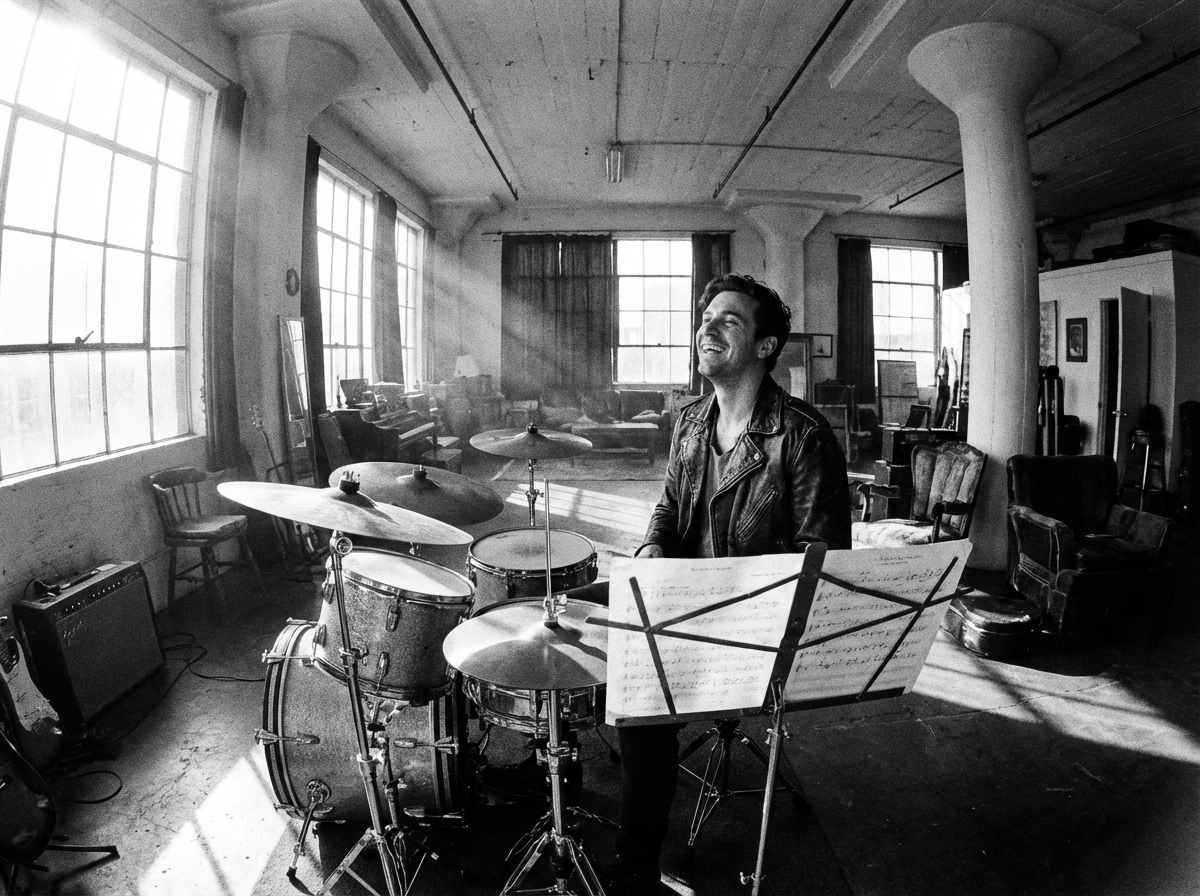
How to Read Drum Sheet Music: The Ultimate Guide to Rhythm Literacy
I remember staring at a piece of sheet music for the first time in the early 2000s. It didn't look like music to me; it looked like a math equation that had exploded on the page. I felt frustrated because I knew I could play the beat if someone just showed me, but this paper barrier was keeping me from the music.
If you are looking at a drum staff and seeing hieroglyphics, you are not alone. It is the single most common frustration I hear from new students. But here is the reality: drum notation is not reserved for the academically gifted. It is simply a language. And just like any language, it has an alphabet and a grammar.
Once you understand the logic behind the symbols—the physics of why a note is placed where it is—you stop decoding and start reading. This guide isn't just about identifying symbols; it is a literacy manual designed to take you from guessing to fluency. We will break down how to read drum sheet music by looking at the two axes of music: pitch (the vertical) and time (the horizontal).
The Vertical Axis: Decoding the Drum Key
Before we talk about rhythm, we need to talk about geography. Many beginners get intimidated by the five horizontal lines, known as the staff. On a piano, these lines represent specific pitches (C, D, E, etc.). On the drums, we don't have traditional melodic pitch, but we do have frequency.
We use a "Drum Key" to map the physical kit to the paper. The logic is simple and based on physics: Low sounds go low on the staff; high sounds go high on the staff.
The "Skin vs. Metal" Rule
This is the most helpful rule I teach beginners to instantly decode a sheet. Look at the "head" of the note (the round part).
- Dots (⚫) represent Skin: If the note head is a solid black dot, you are hitting a drumhead (Snare, Toms, Kick).
- X’s (✖) represent Metal: If the note head is an 'X', you are hitting a cymbal (Hi-hat, Ride, Crash).
The Big Three: Kick, Snare, Hat
Think about your drum kit. Your bass drum (kick) is the largest, lowest-sounding instrument, and it sits on the floor. Consequently, on the staff, the bass drum is found at the very bottom space. Conversely, your cymbals sit high on the physical kit and produce high frequencies, so they sit at the top of the staff.
- Bass Drum: Bottom space (Dot).
- Snare Drum: Middle line (Dot). This is the anchor of your groove.
- Hi-Hat: Top space, sitting just above the top line (X).
If you see a dot on the bottom, stomp your foot. If you see a dot in the middle, hit the snare. If you see an X on top, hit the hi-hat. You just read 90% of all rock and pop beats.
Tom Placement
The toms follow the same "altitude" logic.
- Floor Tom: Low on the staff (usually the second space from the bottom), because it is a low drum.
- High Tom: High on the staff (top space), because it is a high drum.
When you are learning essential drumming techniques for beginners, understanding where these drums "live" on the page allows you to move around the kit without looking at your hands.
The Horizontal Axis: Understanding Rhythm & Math
If the vertical axis tells us what to hit, the horizontal axis tells us when to hit it. This is where most drummers get tripped up, but we can simplify it using a currency analogy.
Imagine a single measure of music (the space between two vertical bar lines) is a box that must contain exactly one dollar. You can fill that box with different combinations of coins, but it must always add up to one dollar.
The Quarter Note ($0.25)
In a standard time signature (4/4), the quarter note is our standard unit of measurement. It is worth 25 cents. You need four of them to fill the measure.
- Visual: A solid dot with a stem.
- Counting: We count this simply as "1, 2, 3, 4."
- Action: You strike the drum right on the count.
The Eighth Note ($0.12ish)
If we split a quarter note in half, we get eighth notes. Now we have eight hits in a measure.
- Visual: A note with a stem and a single "flag" (or a beam connecting two notes).
- Counting: We add the word "and" (written as '+') between the numbers. "1 + 2 + 3 + 4 +".
- Action: Your dominant hand usually plays these on the hi-hat to keep time.
The Sixteenth Note ($0.06ish)
This is where the groove gets interesting. We slice the eighth note in half again. Now we have four distinct hits for every single beat (16 hits in a measure).
- Visual: A note with two flags (or two beams connecting the notes).
- Counting: This requires a specific syllable system: "1 e & a, 2 e & a, 3 e & a, 4 e & a."
The Silent Notes: Rests
Music isn't just sound; it's the space between the sounds. A Rest tells you not to play. A quarter rest looks like a squiggly line (often compared to a bird), and it means "shut up for one beat." Treat rests with as much respect as the notes. A rest isn't a break; it's an active musical decision to create silence.
The Syntax: How to Count (The Grid)
Reading rhythm is not about guessing; it is about using a grid. If you can vocalize the rhythm, you can play it. This is the golden rule of drumming: "If you can say it, you can play it."
The "1 e & a" System
To read 16th notes—which are the building blocks of funk and R&B—we use a specific counting mantra.
- 1: The Downbeat (Main Pulse)
- e: The second 16th note
- &: The Upbeat (Halfway point)
- a: The last 16th note
Pronounced: "One-ee-and-uh".
Try this exercise: Clap a steady pulse with your hands (this is the quarter note). Now, counting out loud, try to fit "1 e & a" evenly inside each clap. This vocal grid allows you to place any note in its correct mathematical slot. Once you master this counting, you can tackle complex drum rudiments with ease because you will understand exactly where each stroke falls.
The Nuance: Dynamics and Articulation
Drumming is more than just hitting the right thing at the right time; it's about how you hit it. Dynamics and articulation are what separate a robot from a musician.
Accents (>)
An accent is a wedge symbol pointing to the right ($>$), placed above or below a note. It means "Hit this louder."
- Anatomy: To play an accent, you don't just "hit harder." You raise your stick higher before the stroke. Potential energy converts to kinetic energy. A higher starting point equals a louder sound.
Ghost Notes (parentheses)
If you see a note head inside parentheses—like this: (x)—it is a ghost note. This is the opposite of an accent. It should be felt more than heard.
- Anatomy: Keep your stick distinctively low, perhaps only an inch off the drum head. It adds texture and "purr" to the groove without dominating the backbeat. Proper execution of ghost notes requires a relaxed fulcrum; check out our guide on how to hold drum sticks correctly to ensure you aren't squeezing the life out of your stick.
Flams and Drags
These are "Grace Notes." They are tiny notes placed just before the main note.
- Flam: One tiny note before the main note. It represents a slightly offset double hit, thickening the sound.
- Drag: Two tiny notes before the main note. It sounds like a quick "r-ruff" leading into the beat.
The Roadmap: Navigation Systems
Reading drum sheet music isn't just about looking at the note you are playing right now. It is about looking ahead. You need to know where the song is going. To save paper and keep things organized, composers use "Roadmap Signs." Think of this as your musical GPS.
Repeats
If you see a double bar line with two dots (||:), that is a start repeat. If you see it facing the other way (:||), that is an end repeat. Everything sandwiched between those two signs gets played twice (unless specified otherwise).
First and Second Endings
Often, a drummer plays a groove for three bars, does a fill, plays the groove again, and then does a different fill. Instead of writing the whole thing out twice, we use bracketed numbers above the staff.
- Play until you hit the bracket marked 1.
- Repeat the section.
- On the second time through, skip the bracket marked 1 and jump straight to the bracket marked 2.
The "Sign" and the "Coda"
- D.S. (Dal Segno): This is Italian for "From the Sign." It tells you to jump back to the symbol that looks like an 'S' with a slash and dots.
- Coda: This looks like a crosshairs or a target. It marks the ending sequence of the song. When you see "To Coda," you jump immediately to the Coda symbol at the very end of the page.
Sight-Reading Strategy: The "Scan-Speak-Play" Method
Now that you know the symbols, how do you actually practice sight-reading without throwing your sticks across the room? I have seen many students fail because they try to play immediately.
You cannot play what your brain hasn't processed. I recommend the Scan-Speak-Play method.
Phase 1: Scan
Before you even pick up your sticks, look at the entire piece. Do not look at the easy parts. Look for the "black spots"—the clusters of complex notes, sixteenth notes, or weird rests. Identify the time signature and the roadmap repeats. Mental preparation prevents panic.
Phase 2: Speak (The Golden Rule)
This is the most critical step. If you can say it, you can play it. If you cannot vocalize the rhythm, your hands will never execute it.
- Put the sheet music in front of you.
- Clap your hands to a steady pulse (the quarter note).
- Recite the rhythm using the counting system: "1 e & a 2... 3 & 4."
- Do this until you don't stumble.
Phase 3: Play
Now, sit at the kit. Set a slow tempo. I personally use the metronome feature inside Drum Coach because it allows me to program the specific subdivision I'm struggling with, but any steady click will do.
- Play the rhythm on just the snare drum first. Ignore the orchestration (toms/cymbals). Focus on the timing.
- Once the rhythm is locked, move your hands to the correct drums (Kick, Hat, Snare).
Developing Fluency
Learning to read drum notation is not a weekend project. It is a slow burn. The goal is to reach a point where you aren't decoding "Dot on bottom line = Kick," but rather seeing the shape of the measure and instinctively knowing the groove.
To accelerate this, I recommend combining reading with writing. Try to transcribe a simple song you love. Listen to the drum beat, identify the kick and snare pattern, and try to write it down. You can use pen and paper, or if you prefer a digital workflow, Drum Notes has a really solid editor that lets you write scores and share them. Writing forces your brain to reverse-engineer the logic, which cements the concepts much faster than reading alone.
If you are looking for specific exercises to improve your reading chops, try incorporating sight-reading into your daily routine. Check out our guide on how to practice with your drum pad for drills that focus specifically on rhythmic recognition.
Reading sheet music gives you access to centuries of rhythmic knowledge. It allows you to communicate with other musicians professionally and learn complex pieces without relying on a YouTube tutorial. It is the difference between reciting a phrasebook and actually speaking the language.
Take it one measure at a time. Count out loud. And keep grooving.
Frequently Asked Questions (FAQ)
What is the difference between drum notation and tab?
Drum notation is the universal standard music language. It uses the five-line staff and specific note values (quarter, eighth) to show exact timing and instrumentation. Drum Tabs (tablature) are a simplified, text-based format using typewriter characters (like -x-o-). While tabs are easy to find online, they often lack precise rhythmic information and can be confusing to read in real-time. Notation is a map; tabs are a rough sketch.
How do you count 16th notes in drumming?
We count 16th notes by subdividing the beat into four parts. The system is "1 e & a".
- 1: The downbeat.
- e: The second sixteenth note.
- &: The "and" (the upbeat).
- a: The "ah" (the last sixteenth note). Pronounced: "One-ee-and-uh."
Where is the bass drum on a drum staff?
In standard drum notation, the bass drum (kick) is located in the bottom space of the staff. If you imagine the staff as a representation of altitude, the bass drum is on the floor, so it sits at the bottom of the page.
What does an 'x' mean in drum sheet music?
The 'X' note head universally represents cymbals (metal instruments).
- X on the top space/line: Hi-hat.
- X above the staff: Crash Cymbal or Ride Cymbal.
- X on the bottom line: Hi-hat played with the foot (chick sound).
How to read drum repeats and codas?
These are navigation markers.
- Repeat Signs (||: :||): Play the section between the dots twice.
- Dal Segno (D.S.): Jump back to the "S" sign symbol.
- Coda: Jump to the ending section marked by the crosshairs symbol. Always scan the "Roadmap" of the song before you start playing so you don't get lost during the performance.
YOU MIGHT ALSO LIKE
Marching Drumline Instruments: The Anatomy of a Modern Battery
Explore the anatomy of a modern marching drumline. From high-tension snares to the front ensemble, learn the physics and instruments of the battery.
Drum Rudiments for Beginners: 5 Essential Patterns to Master
Unlock speed, control, and musicality with this guide to 5 essential drum rudiments for beginners. Master singles, doubles, and paradiddles today.
How to Choose Electric Drums: The Ultimate Buyer's Guide
Learn how to choose electric drums with our expert guide. Discover mesh vs rubber, module features, and the best kits for beginners and apartments.